Blog

  • 11,000 Windows and a Seven-Month Payback: Inside the Century Plaza Towers Retrofit

    Fifteen and a half miles of window film. Eleven thousand windows. Two forty-four-storey towers that never closed for a single day of it.

    I was the project manager on the Century Plaza Towers film installation in Century City, California. It remains the clearest demonstration I have seen of what window film does to a building’s operating cost — and the numbers are public, because 3M published the case study.
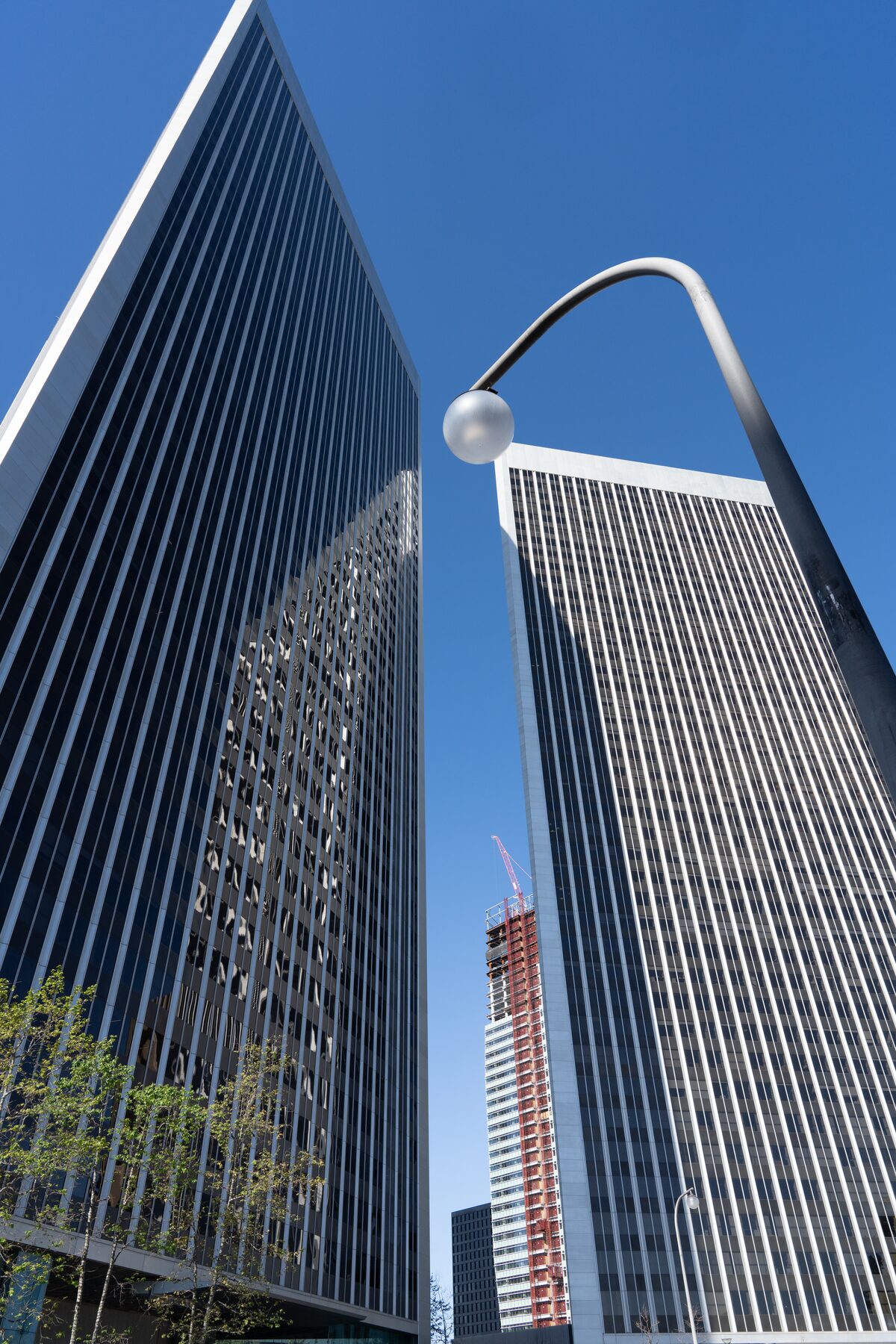
    Twin 44-storey Century Plaza Towers seen from street level against a clear sky
    Two 44-storey towers, three-sided, 2.3 million square feet. With three faces instead of four, there is no elevation that stays out of the sun for long.

    The building, and the problem

    Century Plaza Towers is two 44-storey towers totalling 2.3 million square feet of class A office space. Each tower is three-sided. That geometry is part of what makes them a landmark, and it is also the root of the problem: over the course of a day the solar load moves around the building and never really lets up.

    The practical consequence was temperature imbalance. Tenants on the sun side were uncomfortable while the system was still conditioning the shaded side. Property management at CB Richard Ellis had already pursued other efficiency measures — irrigation management, waterless urinals, a lighting retrofit — and window film was next on that list.

    Why Neutral 35

    On a landmark you cannot simply pick the darkest film on the shelf. These towers have appeared in more films and television than most buildings in Los Angeles, and the glazing is part of their identity.

    The specification was 3M Sun Control Window Film Neutral 35 — high heat rejection with a neutral appearance rather than a mirrored or coloured one. The honest surprise for me was that it improved how the towers read from the plaza. Film evens out the patchwork you get across a large elevation, where some panes have blinds drawn and some do not. Side by side with the before, the building looks more considered, not more tinted.
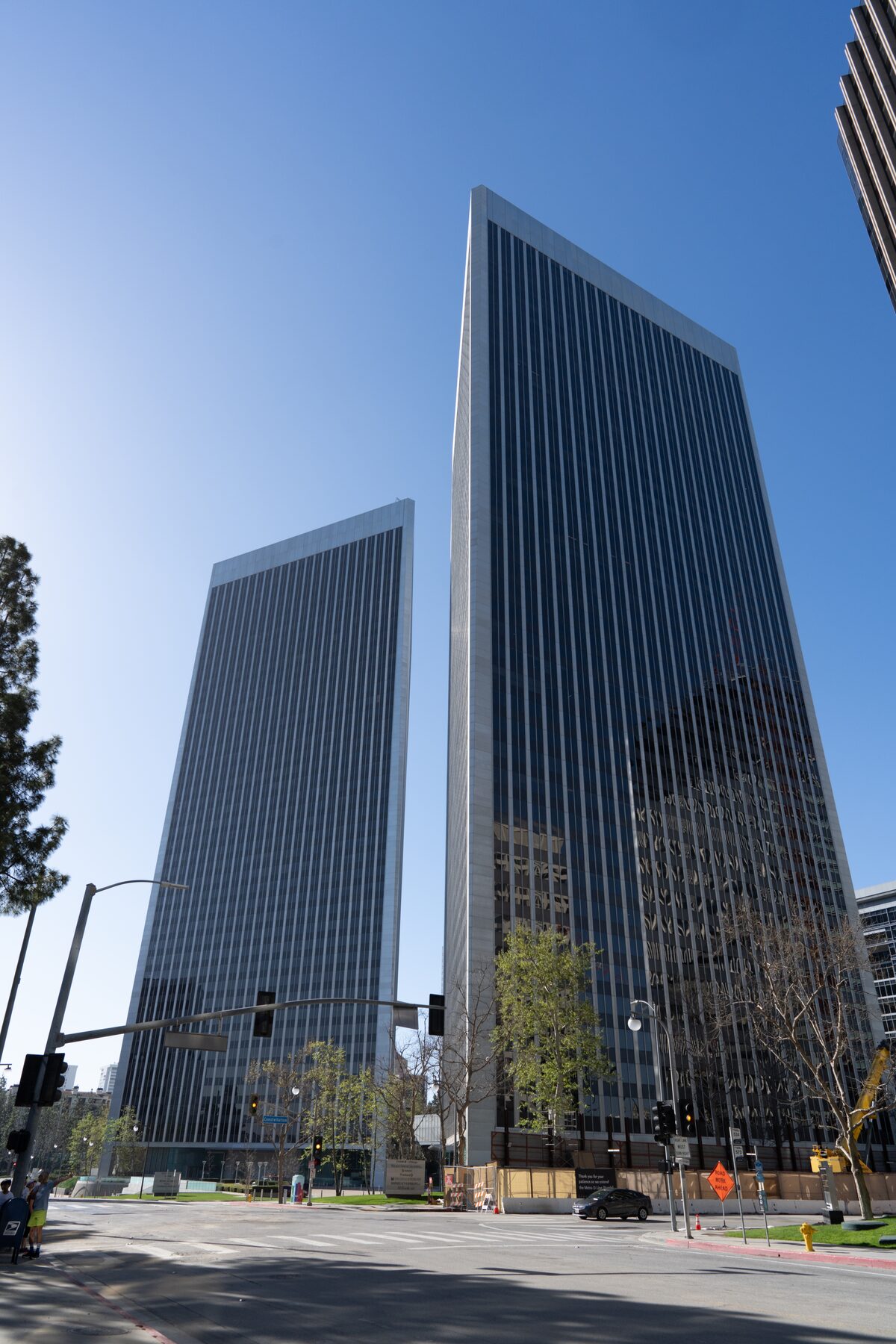
    Century Plaza Towers seen from a street intersection, glazing uniform across both elevations
    Neutral 35 keeps the glazing reading as glass rather than as tint, and evens out the elevation.

    The number that drives everything else

    Neutral 35 rejects 56% of total solar energy on single-pane clear glass.

    Total solar energy rejection is the figure that matters to a building operator, and it is worth being precise about why. It is not shading and it is not glare. It is the proportion of the sun’s energy — visible light, infrared and ultraviolet together — that never becomes heat inside the building.

    Reject 56% of it across 11,000 windows and the chiller is no longer fighting the same building. What changes is not just the thermostat reading but the duty cycle: the system reaches setpoint sooner, runs shorter cycles, and spends less of the afternoon at full tilt. Less run time is less energy, less wear, and fewer service calls.

    What it saved

    According to the published case study, building management saves 155,000 kWh per month following the installation. Utility bills began dropping immediately.

    The Los Angeles Department of Water and Power rebated $116,000 of the project cost. And the payback period, in the words of CB Richard Ellis’s Vice President, was seven and a half months — she described it as one of the easiest capital projects they had ever done.

    That is the part building operators tend not to believe until they see it documented. A capital improvement that pays for itself inside a single cooling season is rare.

    The comfort case, which is harder to put on a spreadsheet

    The energy figure is the one that gets a project approved. The comfort result is the one that gets you renewed.

    A tenant sitting beside west-facing glass in the afternoon does not experience “solar heat gain”. They experience a hot desk, a screen they cannot read, and a thermostat that appears to be lying to them. Nothing generates complaints to building management like a floor that is two different temperatures.

    Rejecting the heat at the glass — rather than removing it afterwards with more cold air — is what makes a floor consistent. The system stops overcooling the shaded side to compensate for the sunny one. That is a comfort improvement and an energy improvement at once, from the same intervention.

    How buildings this size actually pay for it

    Two things make large film projects far more achievable than operators expect.

    Utility rebates. Many providers treat window film as an energy conservation measure and rebate accordingly. At Century Plaza that was $116,000 straight off the project cost. Programmes vary by provider and change year to year, so check before you budget, not after.

    PACE financing. Property Assessed Clean Energy lets qualifying energy improvements be financed through an assessment on the property rather than a conventional loan. For a project with a payback measured in months, the arithmetic tends to work out comfortably. Availability and terms depend on your jurisdiction.

    Rebate plus financing, against a sub-twelve-month payback, is why more operators should be looking at this. The film is not the interesting part. The operating cost is.

    Working around a building that never closes

    One practical note, because it is the question I always get asked. Century Plaza stayed open and occupied throughout — not one tenant lost a working day to it.

    The pace was one floor every night, after hours, plus weekends. Floors 2 through 44, across both towers. Crews went in once the floor had emptied, filmed it, cleaned up and were gone before the building came back in the morning. Four months start to finish, and roughly 15.5 miles of 48-inch film through the door.

    Three windows on the 34th floor had to be done from the outside.

    That is the highest I have ever been on the exterior of a building, and the part nobody pictures is the tethering. Every tool tied off — every blade, every squeegee, every roll, every spray bottle. At that height a dropped hand tool is not a dropped tool. It reaches the pavement at a speed that does not care what it hits. You check the tethers, you check them again, and then you start work.

    It is also the part of this trade I would not trade for anything. Most of the job is a floor at a time in an empty office at two in the morning. Occasionally it is thirty-four storeys up on the outside of a Century City landmark, filming three panes of glass that nobody will ever notice.

    Film is one of the few envelope improvements that can be done this way. No scaffold, no glazing replacement, no tenant relocation. Work a floor at a time, out of hours, and in the morning the only difference anyone notices is that the room is more comfortable.

    Where to start on your own building

    The honest answer is that you should not take anyone’s word for it, including mine. You should have the building modelled.

    We can run an energy audit covering three things: your actual glazing — type, orientation and area; your HVAC system and how it is currently behaving; and a retrospective analysis of your last 24 months of energy use. That produces a projection for your building rather than a number from someone else’s.

    If the figures work, they will be obvious. If they do not, you will have learned that cheaply.


    Houston Solar & Security Film installs commercial solar control film across Greater Houston. For an energy audit of your building, call 346-375-8881.

    Project figures are from 3M’s published case study on Century Plaza Towers, Century City, California. The installation was carried out by Campbell Window Film, with the author as project manager.
  • A Rock, a Mower, and a Classroom: What 8 Mil Security Film Actually Does

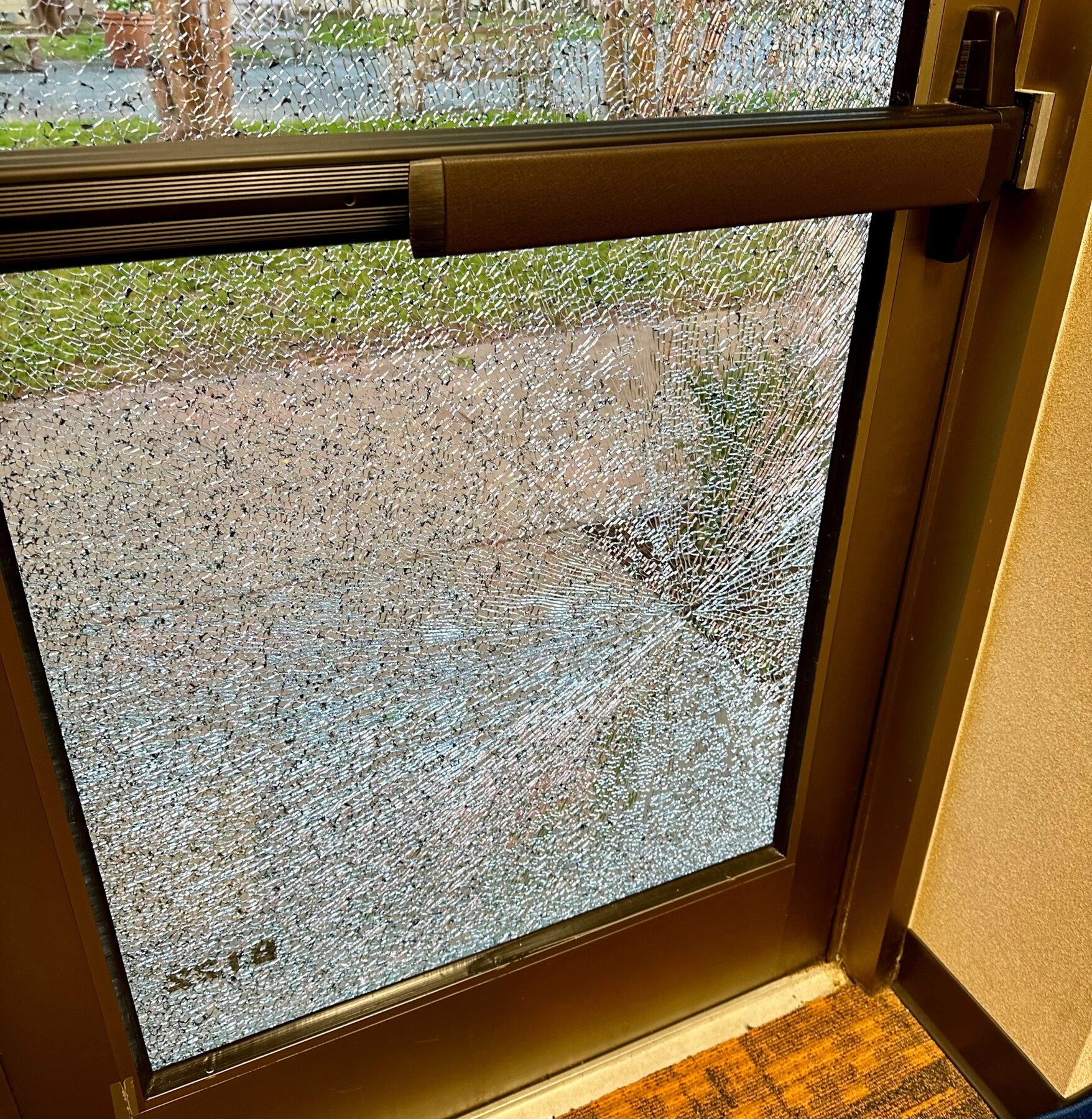
    A landscaper was mowing the lawn outside a school. The blade picked up a rock and threw it at an exit door. The glass let go completely — and not one piece of it reached the classroom on the other side.

    I had installed 8 mil security film on that door the year before. This is what it looks like when it does its job.

    School exit door with a panic bar, tempered glass shattered across the whole panel by a thrown rock but held intact in its frame by 8 mil security film
    Tempered glass does not crack. It lets go all at once, into thousands of pieces. The film is the only reason this is still a door and not a hole.

    What would have happened without it

    Tempered glass is a safety product in its own right. It is designed to break into blunt cubes rather than long blades, and that is a genuine improvement over annealed glass. But it still breaks all at once, and those cubes still travel. A pane this size holds a few thousand of them.

    Without film on that door, the rock would have carried the glass into the room. There would have been a scatter pattern across the floor where children walk. There would have been a hole in the building envelope on a day that could just as easily have been a storm day. And there would have been an afternoon of careful cleanup before anyone could use that room again.

    Instead the pane cracked into its web, sagged very slightly in the frame, and stayed exactly where it was. The classroom was never exposed. Nobody was struck. The building stayed watertight.

    We ordered a replacement piece of tempered glass, fitted it when it arrived, and I came back and installed fresh security film and structural silicone. The door went back to doing nothing visible, which is the point.

    Security film is not really about burglars

    Most people hear “security film” and picture somebody with a crowbar. That is one of its jobs, and it does it well. But in the years I have been installing this material, the incidents that actually come up are broader than that, and the one above is far more typical than a break-in.

    Forced entry

    A smash-and-grab depends on one thing: getting through the glass in a couple of seconds. Film does not make glass unbreakable. What it does is keep the broken glass bonded together so there is no opening. An intruder who expected to be inside in three seconds is now standing in a car park making noise with a visible hole-free door. Most of them leave.

    Windborne debris

    We are on the Gulf Coast. Every hurricane season the question is not whether the wind will move something, it is what it will move and where it will land. The failure that matters in a storm is not a broken window, it is a breached window — once the envelope opens, pressure gets inside and starts lifting the roof. Retaining the glass in the opening is what prevents that.

    Blast mitigation

    In an explosion, most injuries come from flying glass rather than the blast itself. Film with a proper attachment system keeps the pane in the frame and turns the most dangerous thing in the room back into a window. This is why government buildings specify it, and it is a significant part of the commercial work we have done.

    Active shooter delay

    This one needs to be said carefully, because the industry is not always honest about it. Security film is not bullet resistant. It will not stop a round. Anyone who tells you otherwise is selling you something that does not exist at that price.

    What it does is defeat the follow-up. Glass doors and sidelites are commonly defeated by shooting out the lock area and reaching through, or by kicking the pane out after it has been shot. Film keeps the glass assembled, so the opening does not appear and entry takes far longer. In a school or a clinic, that delay is measured against how long it takes for a door to be locked and a room to be cleared. That is the honest claim, and it is a serious one.

    The part nobody mentions: the attachment

    Here is the detail that separates a real security installation from a cosmetic one.

    Film bonds to the glass. If you film a pane and nothing else, you have created one strong sheet — which can now be pushed out of the frame in a single piece. That is better than a shower of glass, but it is not what you paid for.

    8 mil security film going onto school glazing. The second half shows the attachment profile being seated into the frame channel — the step that ties the film to the building rather than just to the glass.

    The film has to be tied to the frame. That is what structural silicone does, and it is why I returned to that school door to do the silicone as well as the film. There are mechanical attachment systems too, depending on the frame. Ask any installer quoting you security film what attachment system they are using. If the answer is vague, keep looking.

    What the mil number actually means

    Thickness is measured in mils — thousandths of an inch. It is the number people fixate on, and it matters, but it is not the whole specification.

    • 4 mil — entry level. Meaningful fragment retention, modest delay. Reasonable for interior glazing and low-risk ground floor.
    • 8 mil — the practical standard for most commercial and school work, and what was on that door. A good balance of forced-entry delay and cost.
    • 12 to 15 mil — specified where the threat is higher or where a blast or impact standard has to be met. Heavier, harder to install well, and genuinely stronger.

    A well-installed 8 mil with a proper attachment will outperform a badly installed 15 mil every time. The thickness is what gets quoted; the installation is what performs.

    Who should be thinking about this

    Schools, clinics, pharmacies, anywhere with a glass entry on a quiet street, anywhere storing stock worth taking, and any building where the glass is close to where people sit. Ground-floor glass in an office. Storefronts. Doors with glass next to the lock.

    And homes — particularly the sliding doors and the glass beside the front door, which are the two most common residential entry points.

    The honest summary is this: you will install it and then nothing will happen, probably for years. The day something does happen, it will be something you never pictured when you bought it. In our case, it was a man cutting the grass.


    Houston Solar & Security Film installs safety and security window film across Greater Houston — Houston, Sugar Land, Katy, Fulshear, Richmond, Pearland, Cypress, Spring, The Woodlands and Conroe. To talk through a building, call 346-375-8881.