A landscaper was mowing the lawn outside a school. The blade picked up a rock and threw it at an exit door. The glass let go completely — and not one piece of it reached the classroom on the other side.
I had installed 8 mil security film on that door the year before. This is what it looks like when it does its job.
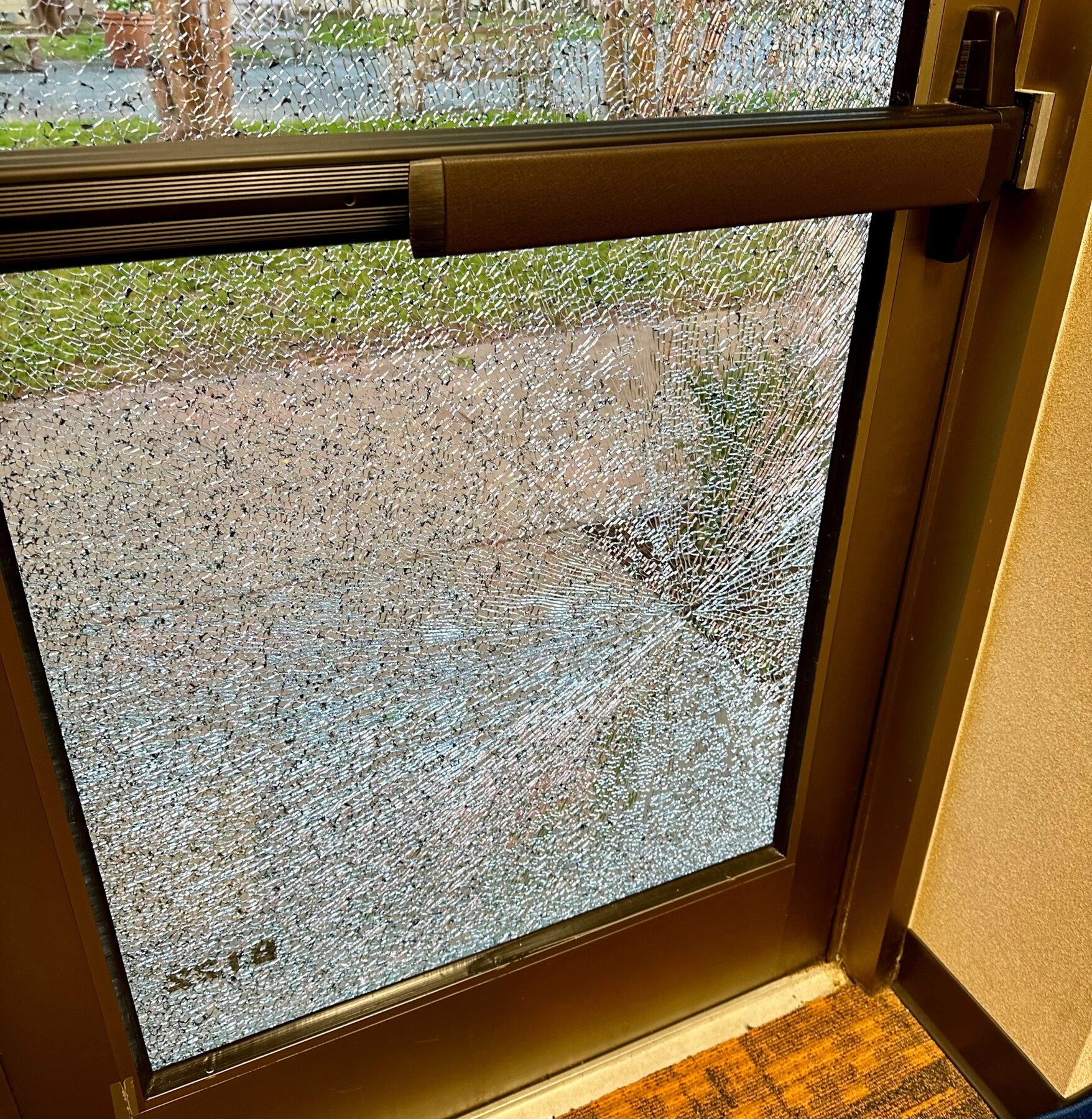
What would have happened without it
Tempered glass is a safety product in its own right. It is designed to break into blunt cubes rather than long blades, and that is a genuine improvement over annealed glass. But it still breaks all at once, and those cubes still travel. A pane this size holds a few thousand of them.
Without film on that door, the rock would have carried the glass into the room. There would have been a scatter pattern across the floor where children walk. There would have been a hole in the building envelope on a day that could just as easily have been a storm day. And there would have been an afternoon of careful cleanup before anyone could use that room again.
Instead the pane cracked into its web, sagged very slightly in the frame, and stayed exactly where it was. The classroom was never exposed. Nobody was struck. The building stayed watertight.
We ordered a replacement piece of tempered glass, fitted it when it arrived, and I came back and installed fresh security film and structural silicone. The door went back to doing nothing visible, which is the point.
Security film is not really about burglars
Most people hear “security film” and picture somebody with a crowbar. That is one of its jobs, and it does it well. But in the years I have been installing this material, the incidents that actually come up are broader than that, and the one above is far more typical than a break-in.
Forced entry
A smash-and-grab depends on one thing: getting through the glass in a couple of seconds. Film does not make glass unbreakable. What it does is keep the broken glass bonded together so there is no opening. An intruder who expected to be inside in three seconds is now standing in a car park making noise with a visible hole-free door. Most of them leave.
Windborne debris
We are on the Gulf Coast. Every hurricane season the question is not whether the wind will move something, it is what it will move and where it will land. The failure that matters in a storm is not a broken window, it is a breached window — once the envelope opens, pressure gets inside and starts lifting the roof. Retaining the glass in the opening is what prevents that.
Blast mitigation
In an explosion, most injuries come from flying glass rather than the blast itself. Film with a proper attachment system keeps the pane in the frame and turns the most dangerous thing in the room back into a window. This is why government buildings specify it, and it is a significant part of the commercial work we have done.
Active shooter delay
This one needs to be said carefully, because the industry is not always honest about it. Security film is not bullet resistant. It will not stop a round. Anyone who tells you otherwise is selling you something that does not exist at that price.
What it does is defeat the follow-up. Glass doors and sidelites are commonly defeated by shooting out the lock area and reaching through, or by kicking the pane out after it has been shot. Film keeps the glass assembled, so the opening does not appear and entry takes far longer. In a school or a clinic, that delay is measured against how long it takes for a door to be locked and a room to be cleared. That is the honest claim, and it is a serious one.
The part nobody mentions: the attachment
Here is the detail that separates a real security installation from a cosmetic one.
Film bonds to the glass. If you film a pane and nothing else, you have created one strong sheet — which can now be pushed out of the frame in a single piece. That is better than a shower of glass, but it is not what you paid for.
The film has to be tied to the frame. That is what structural silicone does, and it is why I returned to that school door to do the silicone as well as the film. There are mechanical attachment systems too, depending on the frame. Ask any installer quoting you security film what attachment system they are using. If the answer is vague, keep looking.
What the mil number actually means
Thickness is measured in mils — thousandths of an inch. It is the number people fixate on, and it matters, but it is not the whole specification.
- 4 mil — entry level. Meaningful fragment retention, modest delay. Reasonable for interior glazing and low-risk ground floor.
- 8 mil — the practical standard for most commercial and school work, and what was on that door. A good balance of forced-entry delay and cost.
- 12 to 15 mil — specified where the threat is higher or where a blast or impact standard has to be met. Heavier, harder to install well, and genuinely stronger.
A well-installed 8 mil with a proper attachment will outperform a badly installed 15 mil every time. The thickness is what gets quoted; the installation is what performs.
Who should be thinking about this
Schools, clinics, pharmacies, anywhere with a glass entry on a quiet street, anywhere storing stock worth taking, and any building where the glass is close to where people sit. Ground-floor glass in an office. Storefronts. Doors with glass next to the lock.
And homes — particularly the sliding doors and the glass beside the front door, which are the two most common residential entry points.
The honest summary is this: you will install it and then nothing will happen, probably for years. The day something does happen, it will be something you never pictured when you bought it. In our case, it was a man cutting the grass.
Houston Solar & Security Film installs safety and security window film across Greater Houston — Houston, Sugar Land, Katy, Fulshear, Richmond, Pearland, Cypress, Spring, The Woodlands and Conroe. To talk through a building, call 346-375-8881.